As global demands for environmental protection and energy efficiency continue to rise, the selection of refrigerants has emerged as a crucial topic in the refrigeration industry. Different refrigerants have their own advantages and disadvantages in terms of environmental performance, energy efficiency, and application scenarios. EPSEA will provide you with a comprehensive analysis of the characteristics of several common refrigerants and their applicable scenarios, aiming to deepen your understanding of refrigerant selection and application.
R22: Phased-out Traditional Refrigerant
- Characteristics:The ODP is 0.05 and the GWP is 1700
- Advantage:It has a mature support system due to years of use
- Disadvantage:It destroys the ozone layer and have been gradually phased out
- Application areas and occasions: The EU has prohibited the use in new equipment since 2015; the United States has banned the production and import since 2020. Now it's only used in some not expressly banned areas(such as some developing countries) to maintain old refrigeration equipment, prohibited for new equipment

R134A: Environmentally Friendly Refrigerant with High GWP
-
Characteristics:The ODP is 0 and the GWP is 1430 -
Advantage:Eco-friendly, non-toxic, non-explosive, high heat exchange performance and low operating pressure -
Disadvantage:Low cooling capacity density and high GWP -
Application areas and occasions:Since 2021, the EU has prohibited its use in certain new vehicle models. In the US, it's still permitted but restricted by the EPA, with a gradual shift to low – GWP refrigerants. China allows its use while encouraging alternatives like R1234yf
Mainly used in fridges, small air conditioners and automotive air conditioners(But gradually replaced by R1234yf)

R407C: Transitional Refrigerant Compatible with R22
-
Characteristics:The ODP is 0 and the GWP is 1770
-
Advantage:Eco-friendly , low operating pressure and compatible with some R22 systems
-
Disadvantage:Zeotropic refrigerant mixture, requires recharging when leaked, low cooling capacity density and poor heat exchange performance
-
Application areas and occasions:No global ban yet, but its usage is on the decline in the EU, the US, and China. Mainly used in small and medium-sized commercial air conditioners and heat pumps(needs regular maintenance)

R410A: The Top Choice for High-efficiency Industrial Refrigeration Equipment
-
Characteristics:The ODP is 0 and the GWP is 2100
-
Advantage:Eco-friendly, high energy density, excellent heat exchange performance, and the first choice for industrial refrigeration
-
Disadvantage:High system pressure (special equipment required) and high GWP
-
Application areas and occasions: Widely used globally(restricted in some US industries). Mainly used in household /commercial air conditioners and heat pumps( high energy efficiency demand scenarios

-
Characteristics:The ODP is 0 and the GWP is 630
-
Advantage:Low GWP, eco-friendly and high safety, it can be directly replace R134A
-
Disadvantage:Low cooling capacity density and high cost
-
Application areas and occasions:Mainly adopted in Europe and America, and gradually introduced in Asia. Mainly used in supermarket freezers, data center cooling and automotive air conditioners(replaced R134A)

Noun Explanation
-
ODP(Ozone Depletion Potential):It is used to indicate the ability of a substance to damage the ozone layer. It is based on R11(ODP=1). The Montreal Protocol, an international agreement, requires the phased-out of substances with high ODP, such as R22
-
GWP(Global Warming Potential):It represents the contribution of a substance to the greenhouse effect within 100 years. It is based on CO₂ (GWP=1). International agreements such as the Kyoto Protocol and the Kigali Amendment impose restrictions on refrigerants with high GWP, such as R410A
Regional Policy Differences
-
EU:The European Union strictly restricts refrigerants with a GWP > 150 and promotes low-GWP alternatives such as R32 and R1234yf
-
US:In the United States, some states like California restrict high-GWP refrigerants, but the federal policy is relatively lenient
-
Asia:In Asia, developing countries such as India still allow the use of R22 during the transition period, but are gradually switching to R410A/R32
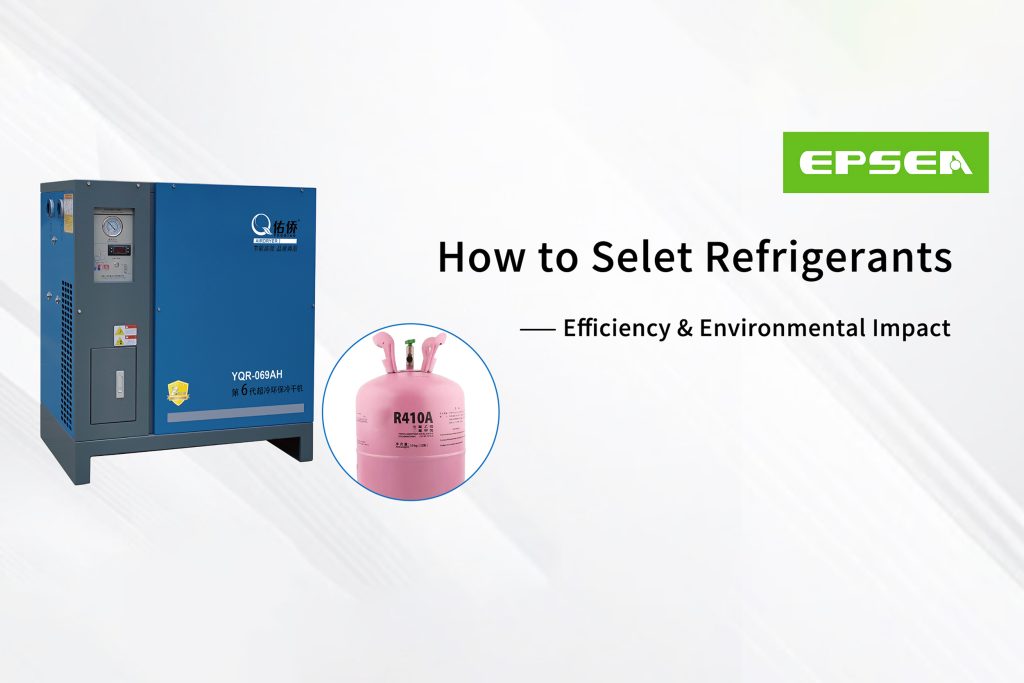
In conclusion, in terms of performance, environmental protection, development trends, and application scope, R410A refrigerant is currently the best choice and the standard refrigerant for the Gen 6 refrigerated air dryers of EPSEA. Meanwhile, we are fully engaged in the research, development, and testing of R513A refrigerant, which holds great potential for enhancing the environmental characteristics and energy efficiency of the next-generation refrigerated air dryers.