Last issue, we introduced the common fault causes and treatment methods of refrigerated air dryers. This issue will share the common fault determination and solution of conventional desiccant air dryer, the working principle and operation process of energy-saving desiccant air dryer, as well as the causes and analysis of abnormal dew point of energy-saving desiccant air dryer. I hope this article can help you better understand the after-sales knowledge of the desiccant air dryer and improve the use efficiency and stability of the equipment. If you encounter any problems during use or need further assistance, please feel free to contact our after-sales service team.
Q1
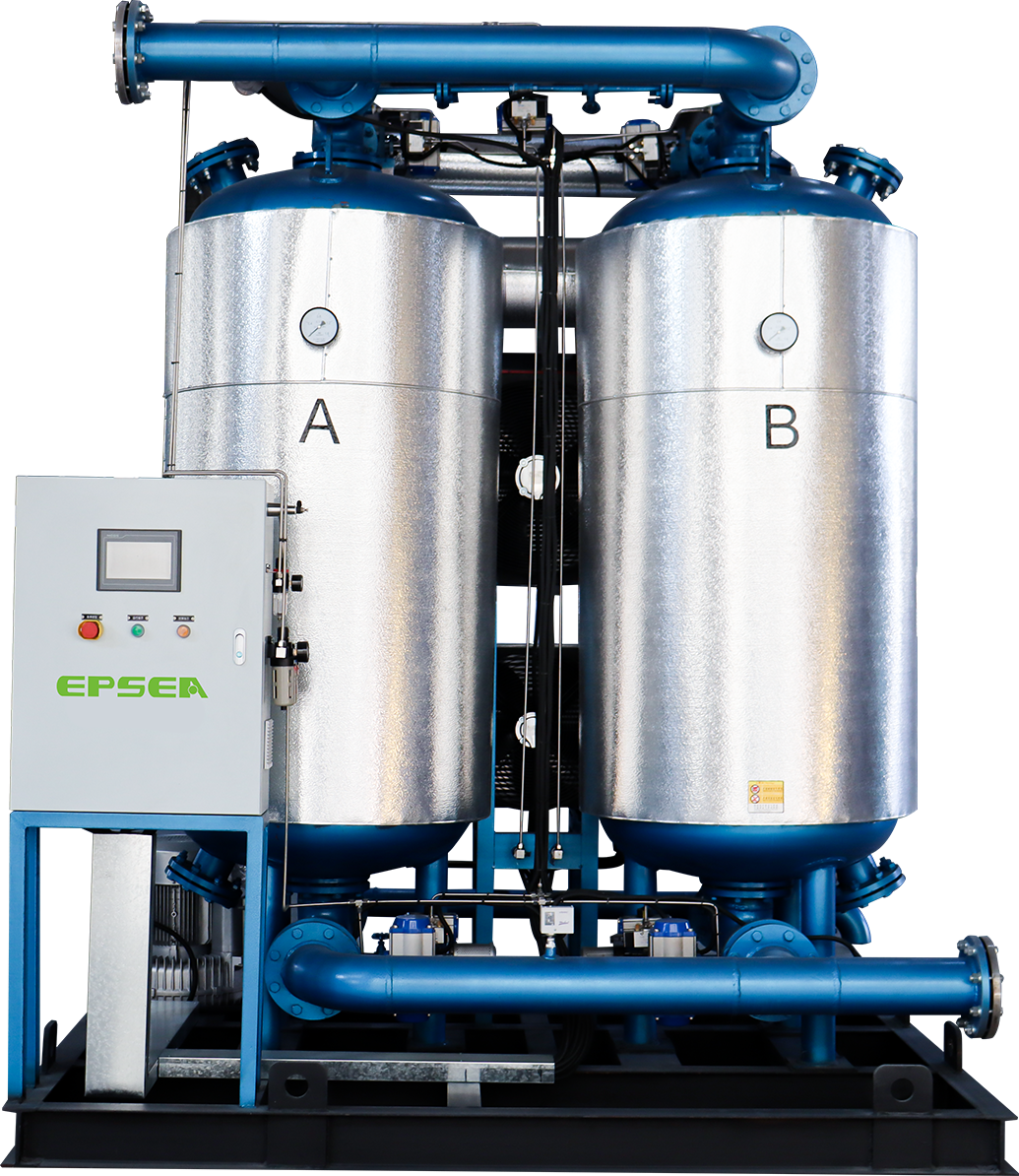
Adsorbent filling density is about 700-750kg/m³, different adsorbent types, different manufacturers will have some differences, alumino silica gel will be larger, molecular sieve will be smaller, the specific can be determined with the manufacturer. Filling density * Volume of adsorption bucket *2 adsorption bucket ≈ Filling amount of adsorbent of 1 desiccant air dryer.
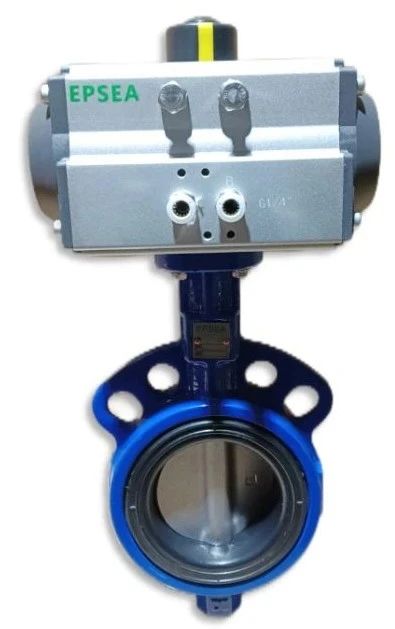
Customers often ask what is the difference between the working principle of the pneumatic angle seat valve and the pneumatic butterfly valve used by the desiccant air dryer?
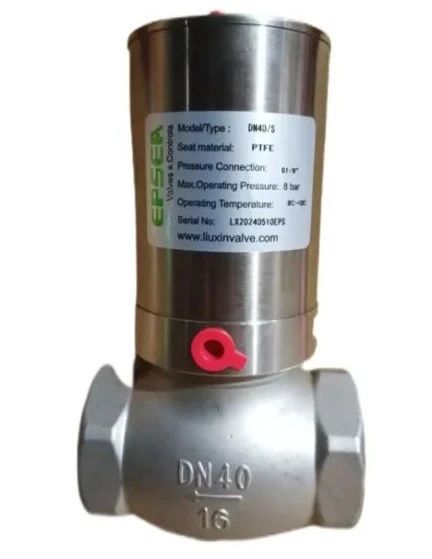
In summary, when the air is suddenly cut off, the pneumatic angle seat valve can be self-reset and the double-acting butterfly valve can not be self-reset.
Q3
Q4
First of all, the intake valve of the A and B towers is set to open in the shutdown state, and the exhaust valve behind it needs to be set to close, and there is a black plastic cap on the top of the pneumatic butterfly valve. There is a yellow or red identifier in the middle of the hat: perpendicular to the direction of the cylinder length indicates that the valve is closed, and parallel to the direction of the cylinder length indicates that the valve is open.
Q5
How to determine the working state of the valve in the operation of the conventional desiccant air dryer is correct?
Under the normal working state of the desiccant air dryer, assume that tower A is adsorbed and tower B is regenerated:
Tower A adsorption, because the compressed air has to go through the adsorption tower and then transported to the back end, the intake valve of tower A is open, and the exhaust valve of Tower A is closed. B tower regeneration, because the pressure regeneration in the bucket needs to be drained, so the intake valve of B tower must be closed before the exhaust valve of B tower can be opened.
Q6
Some customers will ask why the operating parameters of the heat-less desiccant air dryer and the heated desiccant air dryer can not be set to the same?
Because the heat-less desiccant air dryer is based on the principle of pressure swing adsorption, the adsorbent is quickly adsorbed and desorbed, while the heated desiccant air dryer is based on the principle of temperature change and pressure swing adsorption, and the regeneration air is heated by reducing pressure, purging the regeneration tower, and deep regeneration of the adsorbent, so the time can not be set consistent.
Q7
What are the common fault problems and corresponding treatment methods of heat-less twin tower desiccant air dryer?
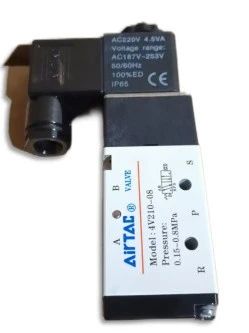
2.The pressure on towers A and B decreases simultaneously in power-on state
① Tower A adsorption, tower B regeneration
Observe the valve status, intake valve A is open, exhaust valve A is closed; intake valve B is close, exhaust valve B is open
②Tower A adsorption,tower B regeneration
Observe the valve status, intake valve B is open, exhaust valve B is closed; intake valve A is close, exhaust valve A is open
③If the above valve and solenoid valve are in normal condition, it is necessary to check whether the check valve of the regeneration tower is in air collusion, and the air has the possibility of backflow.
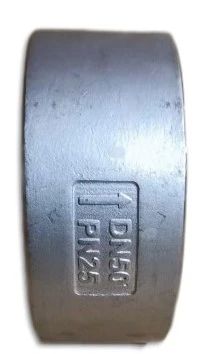
one way check valve
How to define the heating and blowing temperature values of the twin-tower desiccant air dryer?
The corresponding debugging work has been completed when the machine leaves the factory, but if the quality requirements of the terminal air source are different, the heating time and blowing time can be adjusted accordingly.
1. To the heating time, the heated adsorption bucket should reach the ideal heating temperature, indicating that the tail gas temperature is greater than 100℃ (the most ideal effect).
2. To the cooling time, the cooled adsorption bucket should reach the ideal cooling temperature, indicating that the tail gas temperature is less than 45℃(the most ideal effect).
What is the difference between the working principle of the zero loss blower heat and zero loss compression heat ?
Zero loss blower heat desiccant air dryer:
The working principle of the operation is that the compressed air enters the adsorption tower from the air inlet, absorbs from the bottom up, and the dry air is transported to the downstream gas end. The regeneration tower is after the pressure relief, uses the blower to inhale the air in the environment, and is heated to high temperature by the heater. The regeneration tower is blown from the top down to parse out the adsorbent moisture and is discharged into the atmosphere through the exhaust valve. Blowing cold regeneration is to use the blower to provide power source, according to the internal circulation to cool the adsorbent, the high temperature of the adsorbent through the cooler to cool.
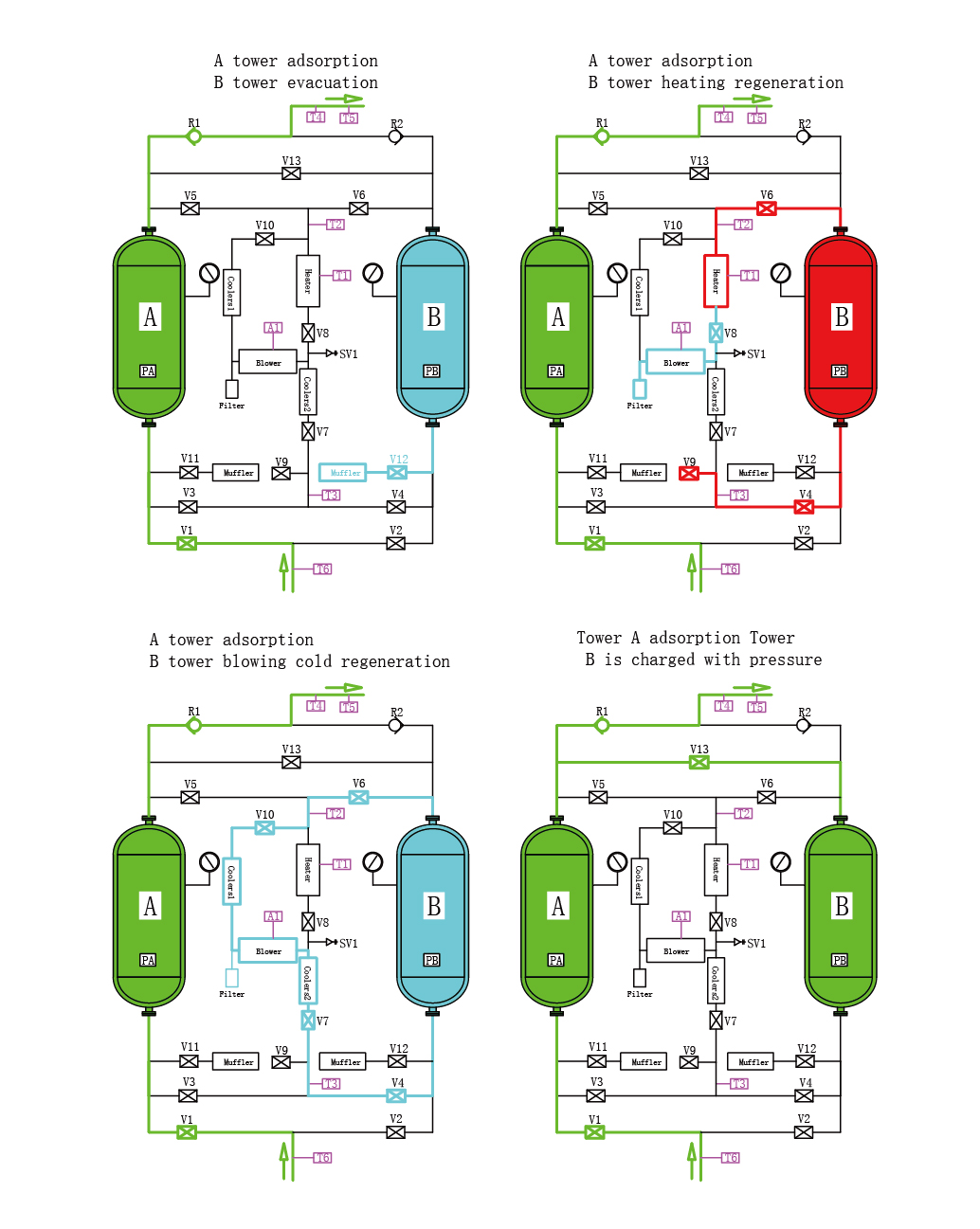
Zero loss compression heat desiccant air dryer:
The working principle of the operation is that the high temperature compressed air first enters the regeneration tower, heats the regeneration adsorbent from the top down, then enters the main cooler to cool down, removes the liquid water in the compressed air through the water separator, and then enters the adsorption tower to adsorb from the bottom up, and the dry air is transported to the downstream gas end. Blowing cold regeneration is the high temperature compressed air advanced cooling in the main cooler, after the water separator removes the liquid water in the compressed air, into the regeneration tower from the bottom up to blow the cold adsorbent to bring out the high temperature heat of the adsorbent, and then into the sub-cooler after cooling again, into the adsorption tower from the bottom up adsorption, dry air is transported to the downstream gas end.
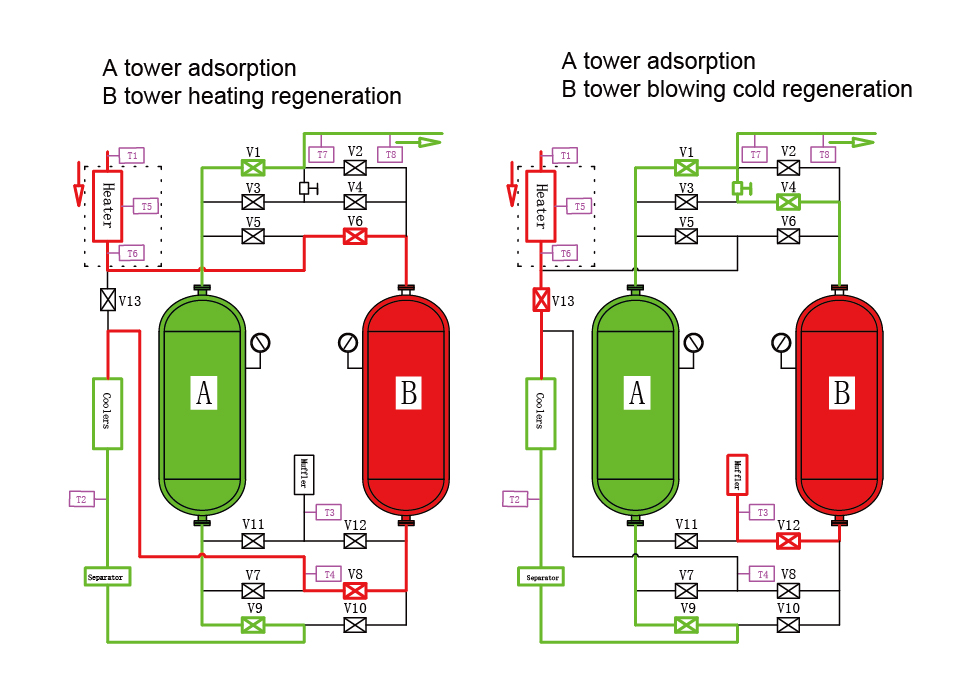
What are the common problems and treatment methods of zero loss blower heat?
The fault of blower heat can be investigated and handled from five directions:
1. Regenerative tower pressure relief failure: Check the pressure relief tower solenoid valve and exhaust valve and check valve
2. The inlet pressure is too low alarm: when the set pressure switch is not reached, the pressure will be turned on after rising 5 kg
3. Inlet temperature alarm: the front end temperature needs to be adjusted to less than 38 degrees
4. Outlet temperature alarm: check whether the blower filter screen is dirty and blocked and observe whether the cooling time is reasonable.
(Air-cooled type: need to pay attention to the ambient temperature; Water-cooled type: whether the temperature of the inlet and outlet of the main and auxiliary coolers is normal, pay attention to the cooling water pipe to observe the water pressure gauge, water temperature gauge, flow rate)
5. The blower current is too high
① Check whether the current protection setting value is in the normal range
② According to the displayed operating diagram, check whether the pneumatic valve of the blower pipeline to exhaust the air is correctly opened or closed
What are the common problems and treatment methods of zero loss compression heat desiccant air dryer?
1. After startup, the screen displays the alarm of valve position failure
① First check whether the pressure of the control valve and pressure regulating valve meets the working pressure of the valve
② Manually test whether the solenoid valve coil is electric or whether the valve core has foreign matter plugs
③ Check whether the valve is open or closed properly
④ Check whether the valve position switch signal is abnormal
2. The dew point of the dry air outlet is too high
① The flow exceeds the rated capacity
② The inlet pressure is too low or the inlet temperature is too high
③ Adsorbent failure: the use period is extended, and the adsorbent is contaminated
④ The drainer system is blocked
3. Severe dew point fluctuation during switching
① Heating is not complete or blowing is not complete (observe the temperature at each stage)
② The cooling water temperature is too high, the heat dissipation effect is poor
③ Scale blockage inside the cooler causes poor heat dissipation
Q12
Cause Analysis of abnormal fluctuation of dew point of energy-saving desiccant air dryer?
1. Check whether the regeneration duration parameter is set properly.
Generally, the design of the adsorption half-cycle time of the desiccant air dryer is 4-6h, the heating and blowing cooling time are roughly half, the actual heating time will be set longer, and the blowing and cooling time will be set shorter, and the basis for determining whether the time setting is reasonable is: within the setting time, whether the heating and blowing exhaust gas temperature can reach the required value. The higher the temperature of the regeneration tail gas, the more thoroughly the regeneration of the adsorbent, and the better the dew point at the outlet of the desiccant air dryer. The lower the exhaust gas temperature, the more stable the dew point at the outlet of the desiccant air dryer when switching.
2. Check the heating temperature, check whether the heating outlet temperature can keep between 140℃and 160℃ of continuous heating when heating regeneration.
3. Check the regeneration temperature, and whether the regeneration tail gas can reach more than 100℃ during the heating regeneration period. During the cooling regeneration period, check whether the regeneration exhaust gas temperature drop below 45℃.
4. When the exhaust gas of heating regeneration and blowing cold regeneration cannot reach the ideal temperature, the regeneration time and heating temperature need to be adjusted according to the site situation.
5. Check whether the compressed air flow rate, air compressor exhaust volume and back-end gas consumption will exceed the capacity of the dryer.
6. Check the cooling effect, the cooler outlet temperature is within 40 degrees, the maximum shall not exceed 42 degrees.
If the outlet temperature is high, you need to check whether the cooling water flow is enough, whether the water pressure is enough, and whether the water temperature is too high.If the water temperature pressure flow is no problem, it is necessary to check whether the inside of the cooler is too dirty and scaled, and clean the inside of the radiator.